

by Check King Tay
In February 2026, I furthered my Research Master project on the British Seamen’s Hospital in Galata at the Netherlands Institute in Turkey (NIT). During my month at NIT, I studied how the British carved, funded, and maintained its healthcare space under the parameters of extra-territoriality. Although many today recognise the hospital from its visual resonance, I was rather interested in the social history of the original, two-storey hospital (plans seen in Images 1-4) at this site that was officially opened to patients by January 1857.
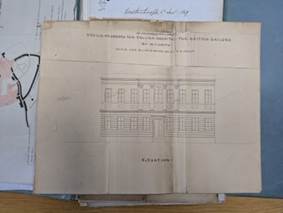
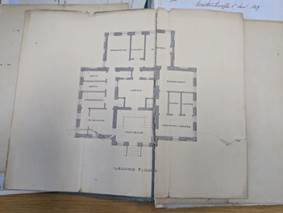
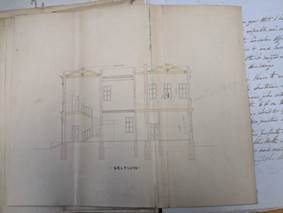
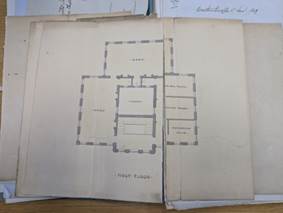
Images 1, 2, 3, 4: front, cross-sectional drawings, ground and first floor layouts respectively in “Plan for a British Hospital at Constantinople”[1]
It was an energising experience working on a project in such close proximity to the subject of my thesis. Having collected primary sources from the National Archive of the United Kingdom before coming to Istanbul, I was naturally excited to come to the urban topography that I had been reading about in primary and secondary sources. NIT was a pleasant base from which I collected Ottoman sources regarding the hospital. Apart from the Ottoman state archive, the wonderful archives at SALT Galata, and rich collection of books across libraries in this area (such as the Istanbul Research Institute) made NIT a cogent location. Collectively, I began to understand the urban property regime that the agents of the British Crown were navigating as the rate of urban construction began to accelerate over the 19th century.
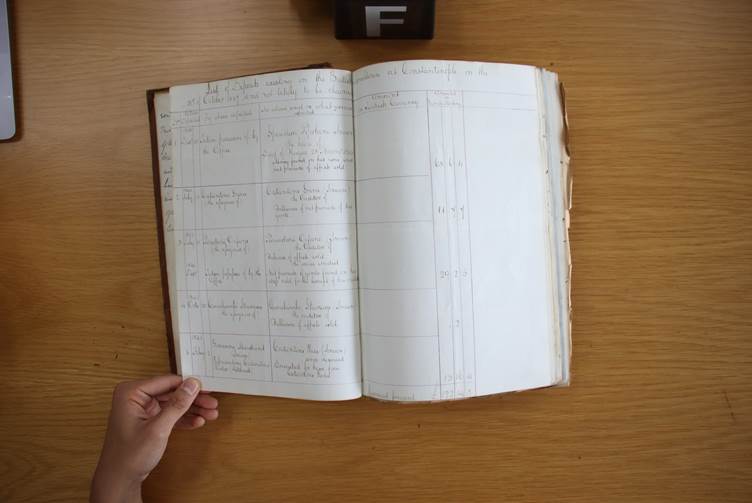
Image 5 – List of Deposits Existing in the British Cancelleria at Constantinople on the 31st of October 1857 and Not Likely to be Claimed[2]
Specifically, this research stint helped me historicise two aspects of merchant activities in the middle of the 19th century. Firstly, I realised that British funding of the hospital stemmed from several historical legacies of British trade. Besides the use of Levant Company funds that the Crown inherited upon the former’s forced dissolution, the Crown kept interesting records such as chancery deposits (Image 5) where the British differentiated between the different “nationalities” of British subjecthood. This helped me historicise the panic in English-language newspapers over immigration of individuals from the Ionian islands, as well as their roles in British trade.
Secondly, merchants were also adept at using the language of extra-territoriality to protest Crown decision-making. In addition to the merchants of Galata, the influence of the British merchants of Smyrna (Izmir) in the late 19th century, as the Crown increasingly tried to integrate the management practices of the seamen’s hospitals at both port cities. Crown agents nonetheless struggled to deal with the different demands of the localised British subjects in each port city, rendering the hospitals’ regulations and power structures a sometimes long and protracted process.
While I work toward the thesis’ completion, I am sincerely grateful for my fruitful time working in the collegial environment at NIT. Research is invigorating, but it is also as much social as it is about individual exploration. I spoke with and learnt from many colleagues from NIT and the broader environment at Merkez Han. Particularly, I am especially grateful to Aysel, Fokke, and Mehmet Bey – all of whom helped me enjoy a relaxing yet productive time here.
[1] W. J. Smith, ‘Plan for a British Hospital at Constantinople’, 12 November 1847, WORK 10/42/1, The National Archive.
[2] Enclosed in ‘Letter from Carlton Cumberbatch to Earl of Malmesbury’, 12 May 1858, FO 78/2067, TNA.