

by Burak Fıçı
Cafés in Paris, London clubs, printing houses in various European cities: according to Jürgen Habermas, these were the key venues where the modern public sphere emerged as a rational space in which members of the urban elite, the bourgeoisie, debated, thereby creating a new buffer zone capable of challenging those in power. Yet what happens if we deliberately turn away from these familiar Northwestern European scenes and look instead to the political ‘edge’ of Europe? What did the public sphere look like in places where a powerful monarchy and confessional institutions continued to dominate public life and, conversely, in contexts where publicness was defined differently, not through printed ideas but oral traditions, not in grand squares but in semi-public settings?
My research questions the formations of ‘an uniform public sphere’ focusing on two busy Southern European port cities: Izmir in the Ottoman Empire and Valencia in the Spanish Empire. In both, urban discourse was strongly shaped by centre–periphery relations, while monarchical religious institutions repeatedly sought to dominate, discipline and confront local decision makers and powerholders. These port cities are particularly revealing because they were also repeatedly struck by disasters. In April 1739, the area around İzmir (Foça) was hit by an earthquake; not long afterwards, in March 1748, another earthquake devastated the region near Valencia (Montesa). Such moments of destruction are not only background noise in history but crucial fault lines and sharp snapshots of how a society operates. Who speaks, who falls silent, who organises relief, who seizes the chaos to strengthen their position? It is not only buildings or material structures that collapse; social (un)certainties, power relations and ideas about who is allowed to speak in public are also radically called into question.
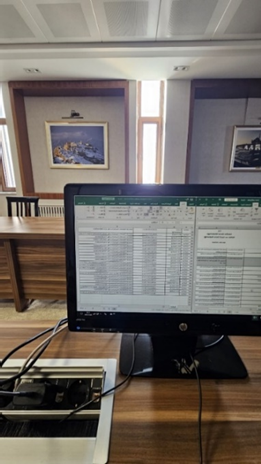
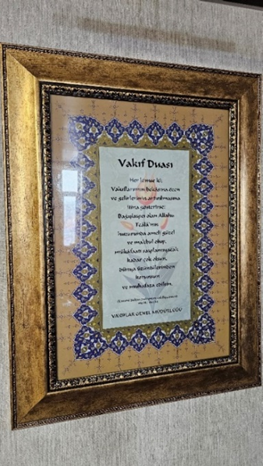
An Inventory of Eighteenth‑Century İzmir’s Religious Institutions (Vakıf registers) in the Vakıflar Genel Müdürlüğü Archives, Ankara.
My project examines the processes of negotiation and asks, very concretely, who gets to speak?
During my stay in Istanbul, supported by the NIT, I was able to search for traces and evidence that the public sphere is much more than cafés, newspapers and ‘enlightened, rationalized and secular’ bourgeois circles. In Valencia, debates about reconstruction run through the corridors of the royal court in Madrid, in royal decrees and reform plans, but also in episcopal letters that frame disasters as divine punishment or moral warning. In Izmir, we find comparable groups and structures that constantly have to negotiate with one another, orally or in semi‑public spaces or via other ways that hardly fit the classical model.
I therefore look not only at archival material to establish “who” comes together “where”, but also where the shared imagination of the public begins and the private ends, who counts as a legitimate speaker and how religious language frames disaster. I do not treat religion as the opposite of modernity or rationality here, but rather as a vehicle of critical debate and political legitimacy. In Istanbul, Ankara and Izmir I collected a wide range of sources in order to develop a new framework for understanding these southern monarchies on different levels: state discourse, the role of local elites, civic voices function and different religious interpretations of publicness.
Finally, I would like to express my sincere gratitude to the NIT, and in particular to Dr. Fokke Gerritsen and Dr. Aysel Arslan, for their generous support.