

by Besime Alikişioğlu
I had the privilege of spending October at the Netherlands Institute in Turkey (NIT) as an Autumn Fellow, where my master’s research transitioned from focusing on the digital sublime to exploring the architectural sublime. During this period, I focused on the sublime in Ottoman imperial mosque architecture in Istanbul, particularly in the seventeenth century, as reflected in Western travelogues and correspondence.
My research at NIT examined Western travel accounts from the 16th to 19th centuries, focusing on how travellers depicted architectural spaces and religious practices. Since the concept of the sublime stems from philosophical ideas, studying it in relation to architecture involves considering aspects such as scale, sound, light, and the observer’s experience. Travelogues are especially useful in this regard because they include detailed descriptions of architecture alongside travellers’ personal impressions of unfamiliar environments.
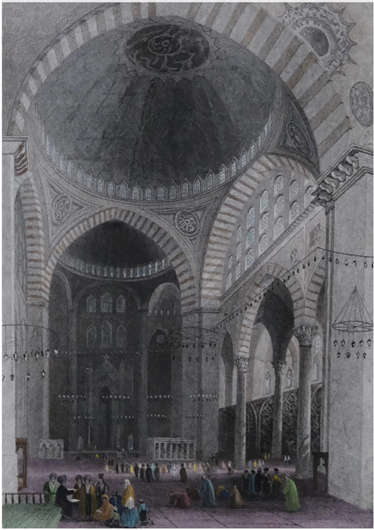
The research involved a close reading of travel narratives, concentrating on the language used to describe Ottoman mosques and religious rituals. The study examined whether words such as “sublime,” “divine,” “immersive,” “overwhelming,” “beyond comprehension,” “vast,” and “awe” conveyed experiences that could be interpreted as sublime. Rather than treating the term as a fixed category, the analysis examined how these effects emerged through descriptive language and emotional responses.
Sources suggest that the concept of the sublime in Islamic architecture manifested in diverse and sometimes conflicting ways. Prior to the rise of Orientalist perspectives in the 18th and 19th centuries, Western travel writings often described imperial mosques in Istanbul as flawed imitations of Hagia Sophia. Simultaneously, Islamic practices such as the call to prayer (ezan) and ritual prayer (namaz) were often depicted as unsettling, evoking discomfort among travellers. These responses frequently conveyed fear and terror, which can be seen as one aspect of the Burkean sublime.
Many Western travellers visited Istanbul in diplomatic roles during a period when the Ottoman Empire was seen as a powerful military and political force. This sense of imperial strength and threat is evident in travel accounts, where fear, awe, and terror are often expressed. For example, Oghier Ghiselin de Busbecq drew an analogy between Ottoman political-religious structures and Christian theological concepts, describing the relationship among Allah, the Prophet Muhammad, and the followers through architectural and ritual symbols such as mosques, minarets, and the call to prayer. These analogies show how travellers tried to make the unfamiliar understandable using familiar Christian ideas, while also emphasising ideas of absolute rule.
This view influences Western portrayals of the Ottoman Empire as a despotic Muslim state, where the sultan is seen as a paternal figure overseeing all subjects. The term “Sublime Porte” (Bab-ı Âli) further supports this interpretation, as entering the sultan’s domain was regarded as confronting a powerful and centralized authority, embodying the sublime as both a political and spatial experience.
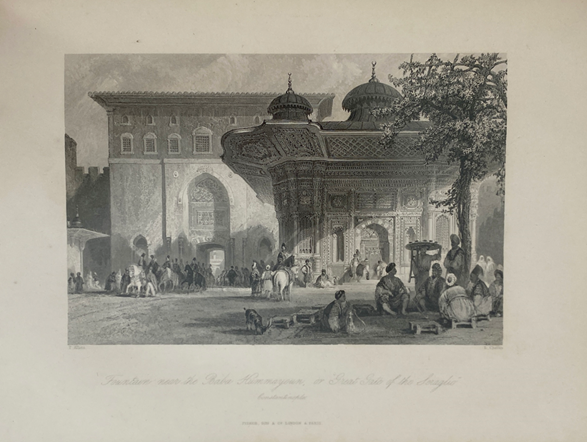
At the same time, a shared emphasis on architectural grandeur is evident in the accounts of both Muslim and non-Muslim travellers. This emphasis gains further significance when considered alongside religious references to light, such as Surah an-Nur (24:35) in the Qur’an and Genesis (1:3) in the Bible. These texts provide symbolic frameworks through which architectural space and light are understood as expressions of divine presence.
Descriptions of the Bosphorus, the Historic Peninsula, and major imperial mosques, including the New Mosque, Sultan Ahmed Mosque, and the Süleymaniye Mosque, highlight recurring themes of grandeur. The writings of Antoine Galland, Adolphus Slade, Thomas Thornton, Simeon of Poland, Edmondo De Amicis, and Théophile Gautier reflected these themes. As Gülru Necipoğlu has shown, imperial mosque architecture was crucial in expressing political authority and ceremonial power. This study builds on that scholarship by examining how foreign observers perceived and described these qualities.
Although this research still needs more in-depth study and has a long way to go, I sincerely thank Fokke, Aysel, and the entire NIT team for their generous support during my fellowship. Their feedback and guidance were invaluable throughout the research process.