

by Ebubekir Düzcan
I had the privilege of spending December at the Netherlands Institute in Turkey (NIT), where I worked on my project, From Karagöz to Cinema: Entertainment Transformations in Late Ottoman Istanbul. I would like to begin by expressing my sincere thanks to Aysel, who kindly helped coordinate the shipment of more than twenty books on old Istanbul to the NIT Istanbul office and made it possible for me to access them during my stay. Being reunited with these materials at the start of my research was both motivating and invaluable.
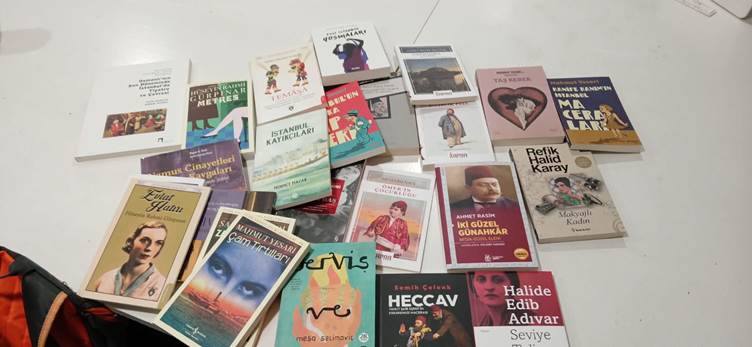
My research focuses on one of the most striking transformations in the entertainment life of late Ottoman Istanbul: the transition from Karagöz shadow plays to cinema, and its sociological implications. In particular, I am interested in how the dense, lively audiences of Karagöz performances gradually became cinema audiences, and what this shift meant in terms of perception, emotion, and collective experience. Rather than treating this transition as a simple technological shift, I approach it as a broader cultural transformation shaped by habits, expectations, and existing forms of spectatorship.
In this sense, the cinematograph, as a “new invention,” did not emerge in isolation but built its audience within already familiar entertainment forms such as Karagöz, meddah performances, and theatre. My research advances two main claims. First, cinema was not an exclusively “Pera” phenomenon; it was quickly embraced on both shores of the Golden Horn, reaching diverse social groups across the city. Second, early cinema’s programming and publicity adapted to local entertainment tools. For instance, while screenings in Pera were sometimes framed as refined “soirées for diplomats,” in other districts such as Direklerarası, cinema was positioned as part of the festive atmosphere of Ramadan entertainment. These distinctions reveal how cinema embedded itself into existing cultural rhythms rather than replacing them outright.
Alongside working with historical archives, I also sought to understand how the entertainment industry was woven into the everyday life of the period—what kinds of habits, fascinations, and even criticisms it generated. Thanks to NIT’s unique location, I had the chance to immerse myself in Beyoğlu, the very district where the cultural pulse of that era once beat most strongly. Walking through its streets while engaging with archival and literary materials allowed me to better imagine how these transformations were experienced on the ground.
Meeting other researchers at NIT was equally inspiring. The opportunity to exchange ideas, even briefly, added an important collaborative dimension to what is often a solitary research process. Within this relatively short period, the materials I was able to consult—especially the novels I read—offered insights that I consider truly invaluable for the development of my work.
I am very grateful for this opportunity. My special thanks go again to Aysel and to Fokke for their support and kindness throughout my stay. I hope to return and continue this work in the future.