
By Britt Postema
From October 6th to November 2nd 2025, I had the privilege of doing research at the Netherlands Institute in Turkey (NIT). My primary aim during my month-long stay in Istanbul was to work on my PhD proposal for the upcoming PhD-calls of the Dutch Research Council (NWO). My research explores the unique hybridity of local identities in Western Asia Minor during the Early Roman Imperial Period through an analysis of monuments set up in urban landscapes. The access to the resources of the NIT and the ANAMED, as well as proximity to the Istanbul Archaeological Museums, meant that the fellowship was an extremely fruitful period for me.
This project was ultimately born from my interest in the Roman World and my fascination with the social function of landscapes and the constructions which people place in them. For a study that combines these two interests, the region of Western Asia Minor is a fascinating case study. Though studies on the impact of Roman rule on the culture of the Greek East have long contained discussions on the monumental environment, these discussions often largely overlooked the communicative power of these monuments. Monuments function as rhetorical and mnemonic devices and are constantly engaged in a conversation with their audience. Through a study of their social function, I wish to explore identity formation and cultural negotiation at the local level of cities, showcasing how the advent of the Roman Empire resulted in hybrid local identities.
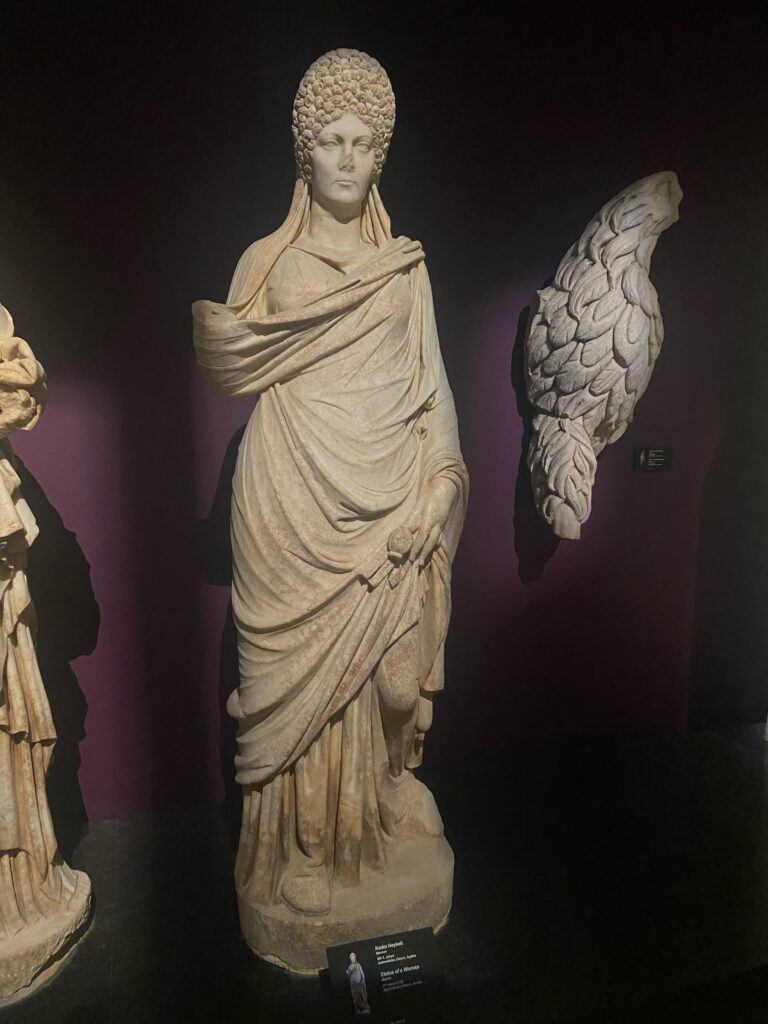
Though as a historian, I naturally use a significant number of written sources, archaeological evidence is crucial, especially for my proposed project. I am nowhere without the actual monuments set up in the cities. Unfortunately, the primary material evidence is scattered throughout historical sites, museums, and archives (a familiar and sometimes frustrating problem known to all historians) and I therefore must often rely on excavation reports, photographs, and catalogues to do my work. My stay at the NIT allowed me not only to access the many interesting articles and books available at the institute and ANAMED, but it meant I could also visit the Istanbul Archaeological Museums, which has a collection of Roman-era portrait statues, some of which are quite valuable to the development of my project. I was particularly pleased that I could see the statue of Celsus, from Ephesus, with my own eyes (and could take plenty of my own photographs!) and my attention was also caught by two ladies from Aphrodisias, who had very distinct hairstyles, clearly inspired by empresses from the Flavian and Nerva-Antonine dynasties. They have become a fascinating part of my analysis of the styles of portraits statues set up in their home city, and seeing them in person did definitely help me better visualise their command of a space.
The stay at the NIT was also very enriching for another, more simple reason: meeting other researchers. At the institute, the working atmosphere was excellent. I thoroughly enjoyed the daily lunches with the NIT staff, other students and researchers working at the institute, and occasional visitors, which allowed for many discussions, on each other’s ongoing projects, or whatever else was interesting at the time. Being able to give a presentation on my ongoing project to staff, researchers and visitors, all of whom were glad to ask questions and give feedback, as well as being able listen to what others were working on was very inspiring. Istanbul is also just an incredibly culturally rich city. It was fascinating to be able to explore its many historical and cultural sites, and as an ancient historian, I was very pleased to find so many traces of the ancient past throughout the city and see how it was interwoven with other parts of the city’s history. All in all, I had a very productive and a great time at the NIT.