

by Ecem Coşan
During my Spring Fellowship at the Netherlands Institute in Turkey (NIT), I worked on the early stages of my PhD research project, “Building a Silk Archive: Tracing Labor, Space, and Non-Human Actors Across the Mediterranean Silk Networks (17th–19th Century).”
My research focuses on three silk-producing regions: Bursa in Türkiye, Piedmont in Italy, and Mount Lebanon. I examine how labor, architecture, and ecological systems shaped silk production between the seventeenth and nineteenth centuries.
When we think of silk today, we often imagine luxury textiles, royal garments, craftsmanship, and museum collections. Silk is usually presented as a finished object: beautiful, refined, and separated from the conditions in which it was produced. Many heritage projects and museum displays still follow this narrative. They focus on patterns, techniques, trade routes, and elite consumption, but say much less about labor, ecology, and everyday production.
Who gets to be preserved within silk heritage narratives, and who remains invisible?
This is one of the core questions of my research.
Although the broader project is comparative, during my time in Istanbul I focused especially on the Türkiye case study. I used the fellowship period to deepen my research on Bursa, one of the most important centers of Ottoman silk production and trade. I looked at archival materials related to Bursa’s urban development, silk factories, production sites, visual documentation, and the traces of the silk industry in the city.
The fellowship was especially useful for me because my project is archive-based. NIT’s location in Beyoğlu was ideal for this work. Since the institute is directly across from SALT Research, I was able to work regularly with archival materials, visual collections, maps, and secondary literature. Beyoğlu itself was also a productive place to think about urban history, material culture, trade, and heritage.
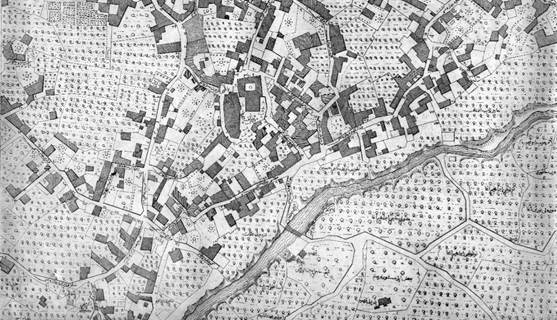
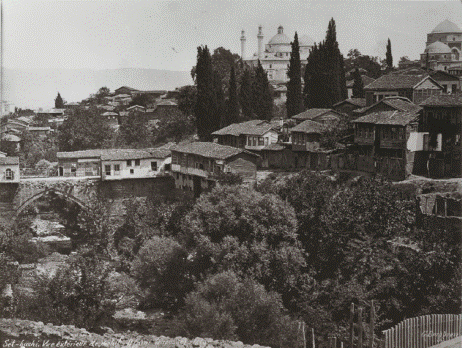
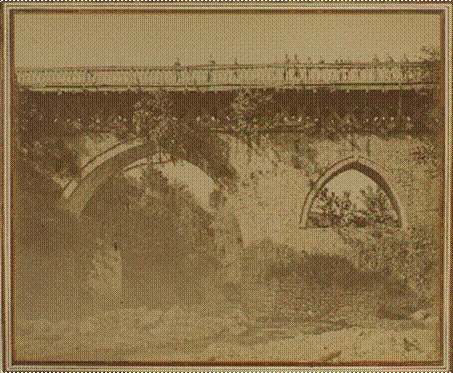
At SALT Research, I found important visual and cartographic material related to Bursa. One of the most useful findings was an early city planning map of Bursa, which helped me think about how silk production was connected to the city’s spatial organization. I also worked with historical photographs taken by early photographers. Through these images, I began tracing the locations and visual memory of former silk production sites. These materials helped me investigate how old factory areas were named, represented, and remembered, and how some industrial traces survived through place names, photographs, and urban fragments.
In addition to SALT Research, I made extensive use of the NIT and ANAMED libraries. These resources helped me develop the historical and theoretical framework of my project, especially around Ottoman urban history, silk production, architectural heritage, and environmental humanities. Having access to these libraries allowed me to move easily between archival material, visual sources, maps, and scholarly literature.
In Bursa, I encountered photographs of young women and girls working in silk-reeling factories. Similar images appear in Italian and Lebanese archives, where women and children are shown doing repetitive and physically demanding work, often under male supervision. These images show how silk production was organized through gendered labor and unequal power relations.
One document that particularly stayed with me was a letter signed as “five thousand young women working in Bursa’s silk mills.” Written in 1909, the letter describes crowded factories, long working hours, withheld wages, and difficult working conditions.
Silk production depended not only on human workers, but also on silkworms, mulberry trees, rivers, humidity, climate, and water systems. In Mount Lebanon, for example, silk cultivation transformed large areas of land into mulberry monocultures during the nineteenth century. This made local food systems weaker and increased economic vulnerability. In Bursa and northern Italy, rivers and water systems were closely connected to silk production, while pollution and waste gradually affected urban life.
During the fellowship, I explored how silk production shaped city forms, industrial districts, bridges, water infrastructures, and domestic workshops. In Bursa, areas such as Setbaşı, İrgandı, Koza Han, and former silk-related streets show how silk production was connected to urban development.
The academic environment at NIT was also very helpful. Conversations with researchers and staff from different backgrounds helped me think about my material in new ways. Even when their work was not directly related to my topic, these exchanges gave me new ideas about archives, fieldwork, urban history, and cultural heritage. I also attended presentations by other fellows, which made me feel part of an active academic community. Overall, these interactions were very motivating.
Lastly, I am very grateful to the Netherlands Institute in Turkey for providing such a supportive and productive research environment. I would especially like to thank Fokke and Aysel for their kindness, help, and attentiveness throughout the fellowship. Their support made my time at NIT both intellectually productive and personally very enjoyable. I look forward to meeting and working with the NIT community again in the future.